
Skip to content
Walla Walla Community College

Purpose of Assessment

STEPS (Systematic Evaluation of Programs and Services) aids in assessing the effectiveness of services, operations, and contributions to WWCC’s mission. The process encourages continuous improvement, data-informed planning, and alignment with college-wide strategic priorities in a manageable and predictable yearly format.

STEPS is tied to the budgeting cycle and supports resource requests by providing alignment and evidence of both the need and impact of resource requests.

Alignment with Strategic Priorities

WWCC’s top priorities are included in the Strategic Plan. When you set your goals, you’ll be asked about the alignment with the strategic priorities within the plan.  You can find them listed here (opens in a new tab).


  2026-27  STEPS Reporting form

(NetID login required)

Timeline

STEPS occurs in two phases.  Divisional Vice Presidents will determine when your reporting area will begin goal setting each year, but the submissions must hit the critical due dates.

Phase 1 – Goals, Measures, and Resources (Part A) Form is due by December 31st each year to meet the budget cycle needs.

Phase 2 – Results, Insights, and Continuous Improvement Planning (Part B)  is due August 1 each year to inform new goals for the upcoming academic year.  Each STEPS Reporter will be sent a notification automatically, requesting an update to report their STEPS results, beginning in April. Reporters will continue to receive notification for this update at regular intervals until results are submitted .

Resources

Who Submits STEPs

Some reporting areas are functional and related to individuals who do similar work or workflows, others are more unit-based.  The reporting areas have been pre-determined by college leadership and and can be viewed below.


***** Admin Services Reporting Areas******
AS-Safety and Security
AS-Purchasing/Motor Pool/Asset Mngment
AS-Student Financials/Cashiering
AS-Payroll
AS-Accounting/Travel/Grants
AS-Technology Services
AS-Facilities & Environmental Services
******Institutional Effectiveness Areas*******
IE-Institutional Research & Effectiveness
IE-Enrollment Strategies
*******Exec Offices Reporting Areas******
Exec Admin-Office of VPI
Exec Admin-Office of VPSS
Exec Admin-Office of VP-PEED
Exec Admin-Office of VPAS
Exec Admin-Office of EDHR
Exec Admin-Office of President
******Operational Dept Areas******
Marketing and Communications Dept
Human Resources Dept
Foundation Dept
******* Student Services Reporting Areas*******
SS-Admissions and Registrar (OAR)
SS -Advising
SS -Athletics
SS-Clarkston Student Services
SS-Office of the Dean of Clarkston
SS-Disability Support
SS-Financial Aid
SS-Outreach
SS-Student Life
SS-Student Support
SS-TRIO
******Instructional Reporting Areas******
INS-Office of Dean of Arts,Sci,TR Studies, & HS Progs
INS-Office of Dean of Nursing & Allied Health
INS-Office of Dean of Workforce Education
INS-WEC
INS-Office of Dean Corrections
INS-Center of Excellence
INS – Center for Teaching & Learning
INS – Library
INS – Academic Success Center
INS – Continuing & Community Education

Setting Measurable Goals

For STEPS, goals must be established, and then we need ways to measure whether we met that goal.

Goals are specific, clear, and measurable.  They set a target that can be measured.

Example: By March, XYZ Dept will decrease the time it takes a student to _______ by 5%, making the process more efficient for students.

For more information about how to write a SMART Goal, see this guide from the University of California.

Setting Actions

Actions are the activities you will do to to meet the goal.

Example: XYZ Dept will create and implement a self-service form for students to directly request ________ which should decrease the wait time.

These are incremental steps on the way to accomplishing your goal. If your goal is to increase retention rates by X% by the end of the academic year, what will you need to do that will affect those rates? Each action might require measurement as a leading indicator of change. If your goal is to establish an annual event, your actions might make up more of a checklist of what needs to be done to pull it off.

Determining What and How to Measure Progress

Once your goal and action is set, you need to figure out how you will know if your actions had any effect on your goal.  There are lot’s of ways to measure and collect evidence of your efforts.  Common measurement techniques include (but are not limited to):

    • Feedback forms or surveys
    • Tracking key metrics (e.g., counts, percentages, ratios)
    • Comparisons over time (before/after, year-over-year)
    • Rate of change analysis
    • Service time improvements (e.g., reduced wait times)
    • Trend analysis
    • Task or milestone completion tracking
    • Other (you can explain)

What type of measurement or measurements will be most helpful to you to know you are on track or accomplished your goal? If your goal was to increase retention rates for a specific student population, then an examination of those rates would obviously be helpful. If improving the student experience, maybe a survey would allow you to gather useful feedback.

What Makes a STEPS Goal Complete?

Here’s a rubric to help guide your creation of your goals, actions, and measurements.  This is just one more tool in your toolkit for identifying your goals, actions, and evaluating whether you’ve accomplished what you set out to do.

STEPS Goal Setting and Assessment Rubric

Putting Results to Work

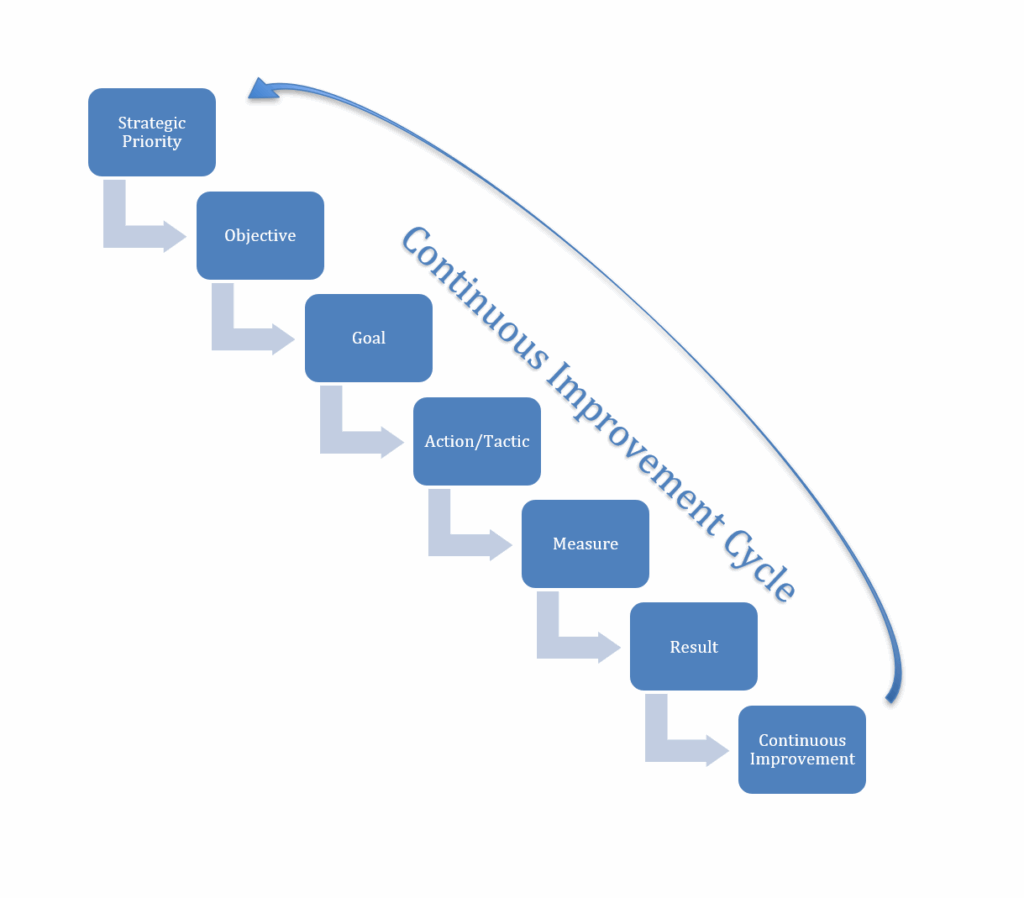
Once you’ve been working on your goal(s) and collecting your evidence of progress, it’s time to analyze those results.  Based on the result, you’ll want to take the next steps.  If you achieved your initial goal, you may want to improve it even more, or set a new goal that capitalizes on your success!  Or if you didn’t meet your goal, you may want to change your actions to see if you can improve your results next year.  Either way, it’s important to take what you learned, and move forward to keep the college in a continuous cycle of improvement.

Here are some examples of how a result might lead to next steps.

Area Goal Result Next STEPS
(Continuous
Improvement Plan)
Facilities Improve rental space request process with a new form 45% of users report confusion with the new form Redesign request form, test with users, + create how-to video
HR Improve employee onboarding experience Only 60% of new hires reported received their new checklist in the email process Automate distribution and assign point-person to follow up
Financial Aid Reduce verification delays by 3 days Reduced delays by 1 day. Investigate using nudges in CRM to speed up the process