A new program is driving hands-on innovation across campus
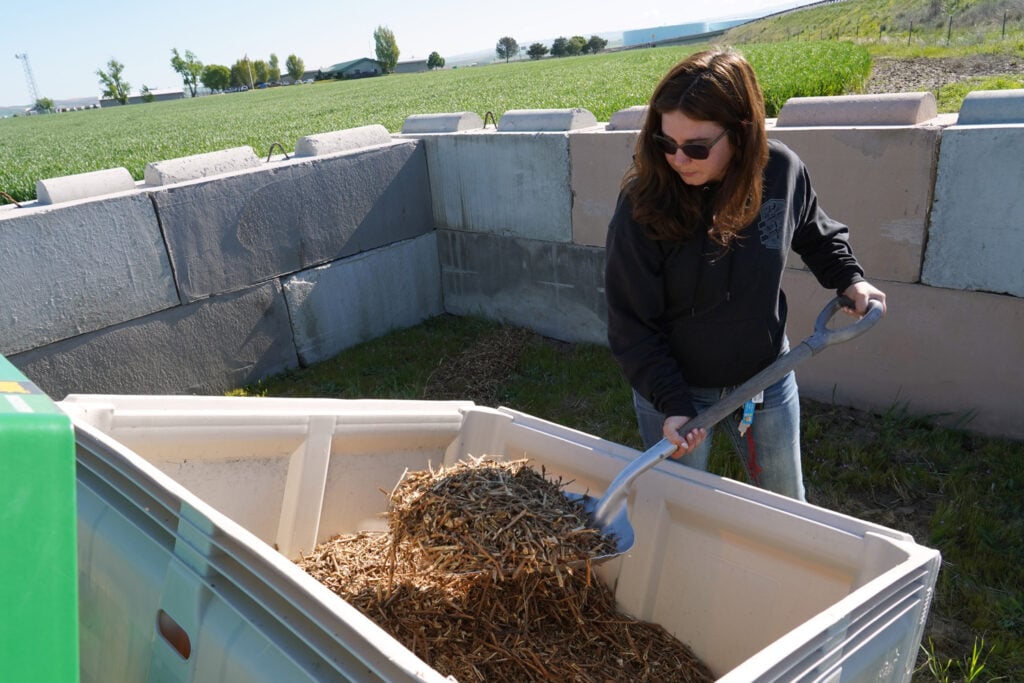
On a spring morning at Walla Walla Community College’s teaching vineyard, Rebecca Sievers is turning vineyard waste into a usable resource.
The first-year student is creating a system to transform grape skins, stems and other organic byproducts into compost to be used in the vineyard.
Her project is one of four funded through WWCC’s Innovation Fund, a program designed to help good ideas take root across campus.
“We’re creating something future students can use,” Sievers said. “It’s not just for now—it’s something that can keep building over time.”
The Innovation Fund grew out of a simple challenge: how to make space for new ideas when resources are limited.
Funded by the WWCC Foundation, the program awards campus projects up to $5,000, with a total pool capped at $20,000 in its pilot year.
The goal is straightforward—support projects that advance student success, whether in the classroom, on campus or in the community.
In its first round, the program drew proposals from across campus, with four selected for funding, each focused on improving the student experience in different ways.
The projects include new culinary software to support recipe management and costing, expanded tools to make online classes more accessible, and sustainability efforts that are already changing how the college manages waste and resources.
For college leaders, the program fills a gap that often limits innovation.
“We don’t have a lot of opportunity anymore to experiment,” said Lisa Chamberlin, WWCC’s Dean of Enrollment Strategies. “There’s not a lot of budget, nor time, nor capacity. This gives people a chance to try something—and see what’s possible.”
One of those efforts is a new glass recycling program, addressing a gap in Walla Walla’s broader waste system.
While most materials can be collected and recycled locally, glass cannot—prompting the college to create its own collection and disposal system. With support from the Innovation Fund, WWCC installed bins across campus and partnered with a regional glass recycler to ensure the material is properly processed.
“Glass can be recycled infinitely,” said Rob Lenahan, the college’s Executive Director of Facilities and Capital Projects. “Even if the volume is relatively small, every piece we keep out of the landfill is a win.”
In the vineyard, the project is not just a sustainability effort, it’s also a hands-on learning experience for students.
For Martin Fujishin, Director of WWCC’s Enology and Viticulture program, the composting project represents both an environmental and educational opportunity.

Winery operations generate large amounts of organic material that often goes unused or is discarded. By creating a composting program at WWCC, the college can demonstrate how it can be implemented at a relatively low cost at wineries in the Northwest.
Sievers’ composting project is both technical and hands-on, giving her the opportunity to design and build a system from the ground up.
Working in the college’s teaching vineyard, she will be layering organic materials, tracking temperature and monitoring how long it takes for different elements to break down.
On a recent morning, that work included feeding pruned vines through a small woodchipper—turning what was once waste into the foundation of the compost itself. The goal is to better understand how those materials can be managed and reused to support long-term soil health.
“It’s something that takes time,” Sievers said. “We’re collecting data, figuring out what works and building something that can be used year after year.”
Joshua Slepin, Director of Institutional Research and Effectiveness, brought the idea of creating an Innovation Fund to the College Council.
“The college was granted a once in a lifetime opportunity with a $15 million unrestricted donation from McKenzie Scott in 2020. The interest from that and other donations gives us the ability to explore and foster good ideas that may benefit students and our communities that might otherwise never see the light of day,” he said. “Good ideas can come from anywhere or from anyone. If they prove successful, the college can consider ways to sustain the work.”
More information about WWCC’s Innovation Fund is available on the college’s website: https://www.wwcc.edu/about/leadership/college-council/innovation-fund/