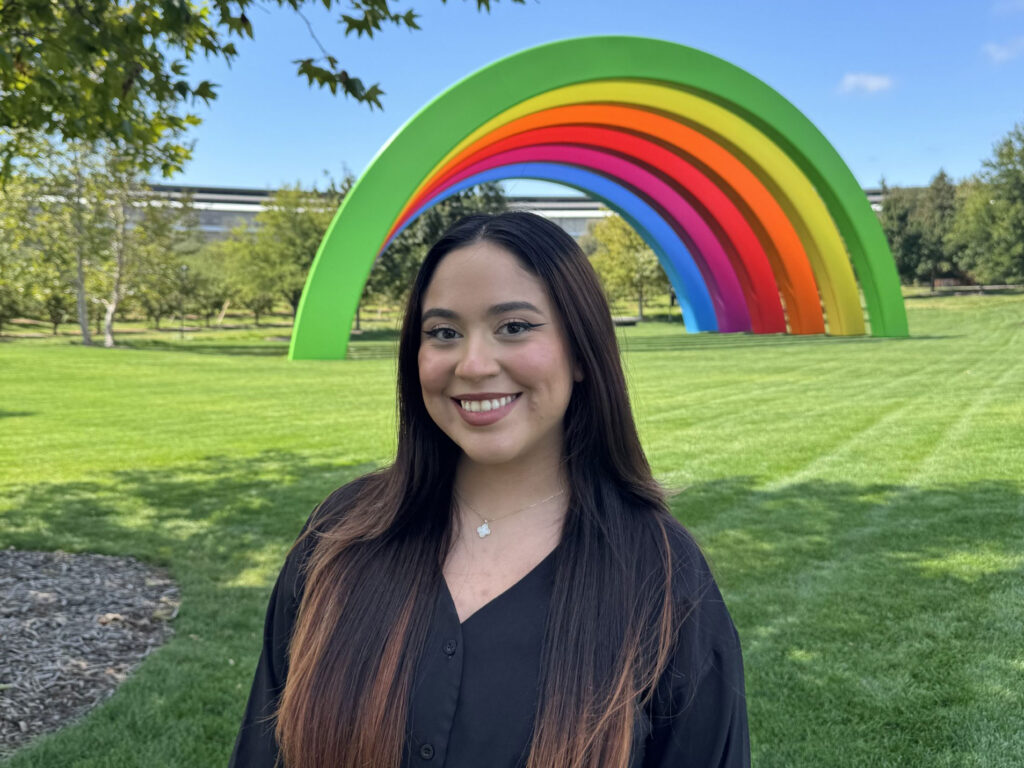
Alondra Sustaita describes herself as a “dedicated” student. She earned a perfect, 4.0 grade point average in high school and was very involved in extracurricular activities. She assumed that she’d go on to a four-year university after graduation.
Her father had other ideas.
“There are people who consider college to be expensive and question its value. And my father was one of them,” she says. “I felt discouraged and lost.”
Eventually, Sustaita and her father found a compromise: She would take her first two years of college close to home at Walla Walla Community College. While it was a compromise, Sustaita says she quickly realized the benefits of starting her higher education journey at WWCC.
She connected with TRIO, a program providing low-income students who may also be the first in their families to attend college with financial, academic and other supports. Sustaita also landed financial grants and a scholarship from the WWCC Foundation. Through TRIO, she learned about a Ford Family Foundation Transfer Scholarship and connected with Launch@Apple, a program sponsored by the giant tech company to provide mentorship and professional development for first-generation students.
Sustaita left WWCC with an associate degree in business in 2021. She transferred her credits to Portland State University, where she finished her bachelor’s in business administration. Today she lives in California’s Bay Area and works a job she loves as a financial analyst in Apple’s real estate division.
“I was determined because I felt like higher education put me on the right pathway to where I wanted to be,” she says. “And I was determined to prove to my father that college was a real possibility.”
Multiple studies show that individuals who pursue college education enjoy more employment opportunities and have higher earnings potential. A May 2024 analysis of 53,000 degree programs by the Foundation for Research on Equal Opportunity revealed that bachelor’s degree holders earn a median $32,112 more annually than high school graduates.
Numerous other studies show that students who pursue alternatives to the four-year degree path, such as an associate degree or workforce certificate also realize lasting benefits.
Subhead: WWCC programs evolve to meet local demand
Recent studies also find students realize the most value from college when they are trained for jobs that are in high demand, including mechanics, welding and health care. As a community college, WWCC has a long history of partnering with local and regional employers to design and develop programs that set both students and employers up for success.
Key Technology, one of the region’s largest private employers, has hired about a dozen students from WWCC’s Welding Technology program.
“We’re proud to support the WWCC welding program,” said Justin Shelton, senior operations manager at Key Technology and a member of the WWCC Welding Advisory Committee.
“The training students receive prepares them for both immediate success and long-term career growth,” Shelton says. “By partnering with programs like this, we’re able to strengthen our workforce here in Walla Walla while also supporting the broader welding industry across the country.”
Kristopher Margart, a Welding instructor and Chair of Manufacturing Trades at WWCC, says graduates of the program typically earn $22 to $53 an hour right out of school. The Local 598 Plumbers and Pipefitters union also helps place WWCC graduates as apprentices, giving them additional training that also positions them to earn competitive wages.
“Our students have a head start,” Margart says. “They learn the ethics of the shop, how to conduct themselves on a job site, as well as safe practices and the basic knowledge of blueprinting and welding.”
WWCC’s program also adjusts to employer feedback. The college recently sharpened its instruction in blueprint reading as well as expanded its fabrication shop with the latest equipment and added outside welding stations because that’s often the real-world working conditions.
WWCC’s Diesel Technology program was created in the 1980s to teach students the skills needed to repair agricultural equipment. Today’s students also get hands-on experience with heavy trucks and other off-road equipment. Students can earn a one-year certificate or go on to take a two-year associate degree.
Those with one-year certificates typically start at $25 an hour and second-year students can earn $30 to $35 an hour very quickly, says Arnold Weaver, WWCC’s second year Diesel Technology instructor.
“Every improvement we make in the program is focused on making sure our students are employable in today’s market. We partner with employers to find the right pathway for our students,” Weaver says.
Like Welding, WWCC’s Diesel Technology program benefits from an advisory council comprised of local employers who provide input on curriculum and offer students internships and eventual employment.
Subhead: Meeting the region’s health care needs
The U.S. Department of Labor Statistics expects health care to be one of the fastest growing sectors in the nation with qualified workers in high demand through the next decade. WWCC’s Nursing and Allied Health Program offers a myriad of opportunities for students such as a two-year associate degree in nursing and certificates that include nurse assisting, phlebotomy, medical assisting.
“We’re making sure that we’re keeping our finger on the pulse of what our local communities need,” says Jennifer Clayton, WWCC’s Dean of Nursing and Allied Health.
For example, she says, WWCC re-introduced a Medical Assisting certificate after hearing from physicians, clinics and others about a shortage of trained people in this area.
Clayton says the resources available to students are another benefit of training at WWCC.
“It’s amazing to see a whole team rally around a student to help them get through the program, whether that means identifying financial assistance or other resources.”
In addition, the college secures clinical internships for students. Even before they finish their classes, students and their potential employers can see whether they are a good fit.
“I always encourage students to ask whether the path they are considering at WWCC is worth their time and investment,” Clayton says. “To me, the answer is ‘absolutely.’”
Alondra Sustaita, the WWCC student now Apple employee, says the degrees and experience she earned through college are invaluable for her.
What does her dad say now?
“He’s really proud of me,” she says. “He realized that it is possible for somebody with my background to make it work. Today, my younger sister, Maciel Sustaita, is a WWCC student in the Culinary Arts program. And I’m super proud of her.”