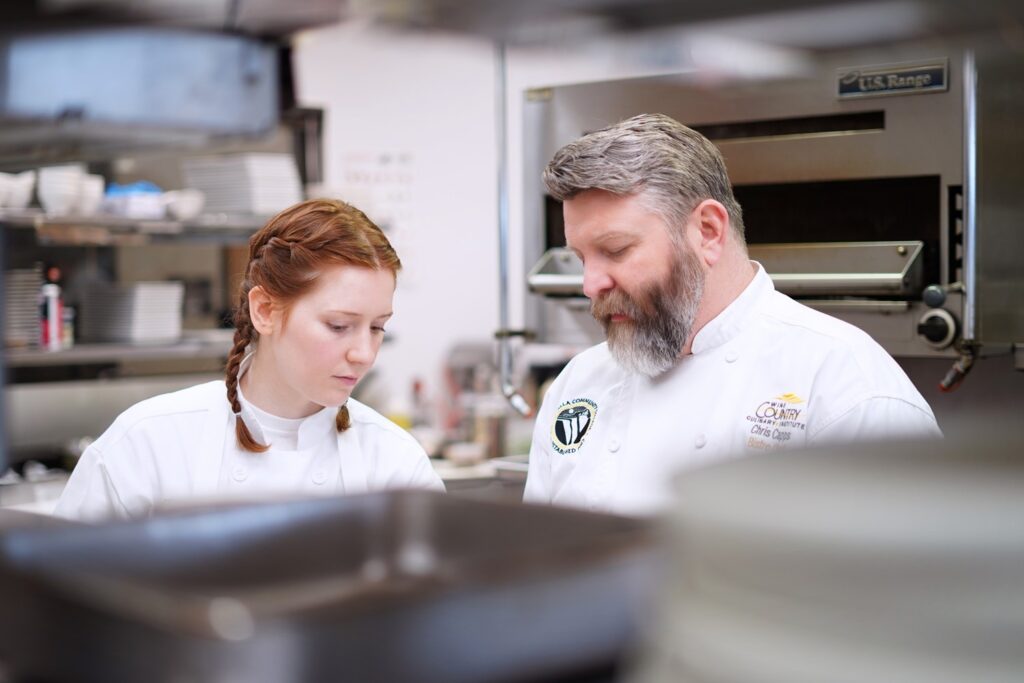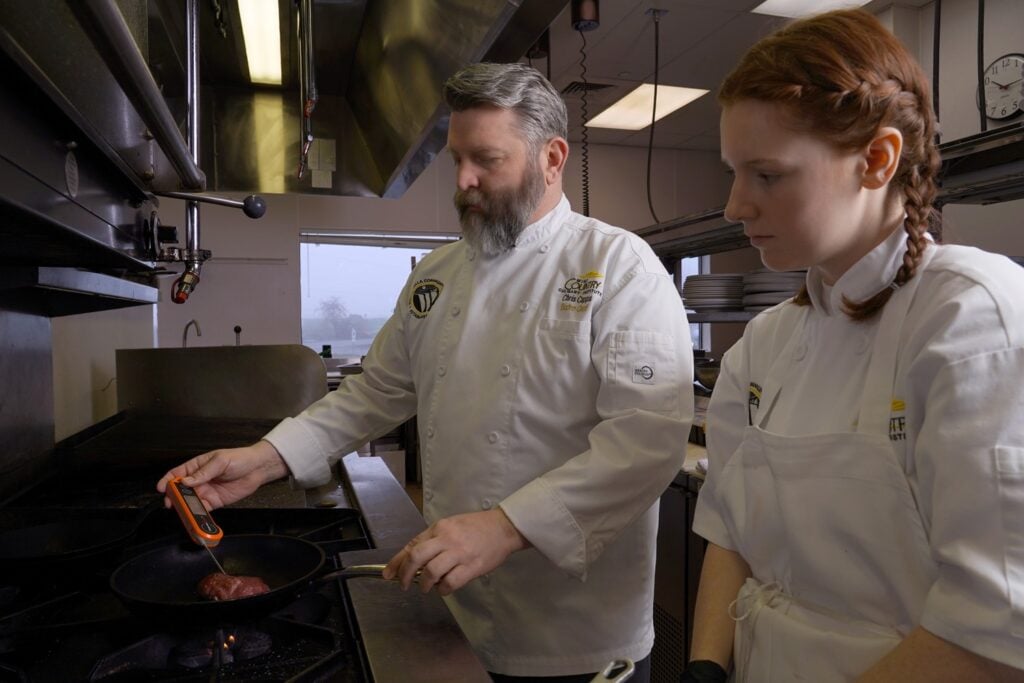
On a recent weekday afternoon at Walla Walla Community College, the dining room at Capstone Kitchen hums with quiet intensity. In the kitchen, students move between stations — sauté, pantry, pastry — under the watchful eye of chef instructor Chris Capps. For the diners, it’s a delicious lunch. For the students, it’s where months of classroom learning are put to the test.
Capstone Kitchen is the student-run restaurant of the Wine Culinary Institute at Walla Walla Community College and a key part of the college’s culinary arts program, giving students real-world experience before they enter the food and hospitality industry. Open to the public from September through mid-March, the restaurant serves lunch three days a week — offering the community a fine-dining experience while students put their training into practice.
“This is a working restaurant,” said Capps, who joined the college in 2024 and stepped into the chef instructor role following the retirement of longtime instructor Robin Leventhal. “We try to recreate the pressure, deadlines and expectations of a professional kitchen, but in a space where students can learn, make mistakes and grow.”
Each service seats about 40 to 50 guests over a two-hour period, with students rotating weekly through front- and back-of-house roles — from sauté and pantry to serving and bussing. A utility role ensures students learn to step in wherever they’re needed, as they would in a commercial or restaurant kitchen.
“You see a lot of anxiety at first, especially in the front of the house,” Capps said. “But over time, their confidence really builds. By the end, they’re comfortable talking to guests, managing time and handling pressure — that’s what employers want to see.”
Menus change every week and are designed with student input. Prices vary depending on ingredients, but meals are intentionally kept more affordable than comparable restaurants. In the fall, Capstone typically offers a prix fixe menu; winter menus feature à la carte options that expose students to real-world ordering decisions.
For Chris Teal, owner of Teal’s Produce, Capstone Kitchen represents something he wishes had existed when he was a student. Teal, a local produce distributor serving restaurants across Walla Walla, graduated from the college’s culinary program in 2005.
“I’m jealous of these students,” Teal said with a laugh. “What they have now is nothing like what I experienced. I hope they realize how good it is.”
Before launching his produce business, Teal spent 16 years as a chef, experience that shapes how he works with restaurants today — and why he values programs like Capstone.
“These students get to cook in a live setting without the full weight of industry demand,” he said. “It’s eye-opening. They’re learning not just how to cook, but how a kitchen actually functions.”
Teal also serves on the program’s advisory committee and believes formal culinary education offers something the job alone cannot.
“Cooking is the fun part,” he said. “But WWCC’s culinary program teaches students how to build a menu, manage costs, understand supply chains, do culinary math — all the things you need to succeed in the industry. And having that degree matters.”
For student Lillian Davis, 27, Capstone Kitchen is both an ending and a beginning. This is her final quarter in the culinary program, though she is staying at WWCC to complete a bachelor’s degree in business marketing.
“I know I want to work with food and people,” Davis said. “Probably in product development or marketing. I really care about food education — helping people understand what they’re eating and where it comes from.”
Davis returned to school after working as a restaurant manager and realizing she wanted more opportunity and stability.
“There’s so much more than cooking,” she said. “We learn organization, business planning and menu design. For our final, we had to write a full business plan.”
At Capstone, Davis has rotated through every station and particularly enjoys pastry and front-of-house roles. When assigned appetizers, Davis prepared couscous salad and mushroom soup. Desserts include cinnamon banana cake and sorbet. Students research, test and refine their dishes themselves.
One of the most valuable tools, she said, is immediate customer feedback.
“We get comment cards after every meal,” Davis said. “By the end of the week, we can sharpen things and really improve. That feedback is huge for learning.”
Beyond the kitchen, Capstone Kitchen reflects WWCC’s deep ties to the local food community.
“I don’t think people realize how interconnected this program is with the local community,” Davis said. “Community colleges matter. Programs like this make education accessible. Culinary school is usually very expensive, and being able to do it here is incredibly important.”
For Capps, the message to the community — including potential students, employers and supporters of the college — is simple.
“I want people to know we’re here,” he said. “These students are making real sacrifices to learn and grow and their passion keeps them going. Supporting Capstone — by dining here, spreading the word or encouraging someone to enroll — is supporting the future of our local workforce.”
Reservations are required and can be secured through OpenTable.